Marcin Dudek
1996, 2018
Image transfer, acrylic paint, uv varnish, cloth tape on wood and aluminium
200 x 150 cm
78 7/10 × 59 1/10 in
78 7/10 × 59 1/10 in
Copyright the artist & Harlan Levey Projects
1996. A year characterized by intensive travel from stadium to stadium, where riots, fights, trains, buses and communist architecture were constants. Inspired by the stadium fencing in Krakow, the work...
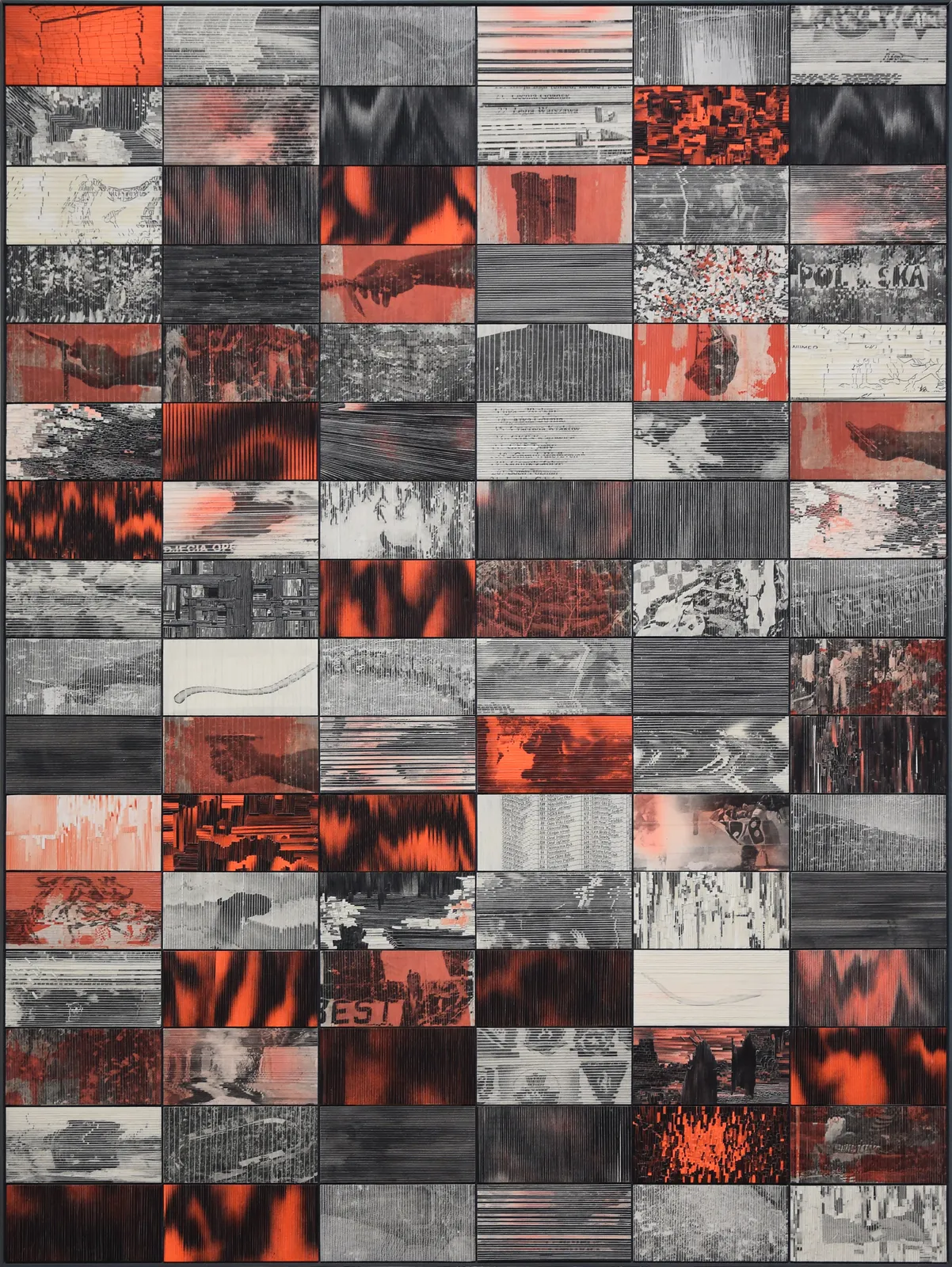
1996. A year characterized by intensive travel from stadium to stadium, where riots, fights, trains, buses and communist architecture were constants. Inspired by the stadium fencing in Krakow, the work is divided into a collection of disjuncted images that can be seen as a kaleidoscopic view of a year. The fence is the same model as in Dudek’s work The Protectionist Reflex, symbolising the institutional attempt to separate the world of the stadium from the comparatively orderly exterior. This attempt at containment takes on the same aesthetic as the modules of concrete slabs used in housing or for the Berlin wall - a purely mathematical way of distributing and separating human beings. The repetitive shapes reproduced in the work each show a different aspect of humanity - different emotions, perspectives, and memories seen from a distance. Just as fences cut us off from the other side, in this work we only have access to the reshaped and reinvented vision that the artist chooses to present to us.
Each of the 96 frames shows a close-up of archival or collected images. Through strategies of cropping and collage, the viewer is prevented from seeing the entirety of the images portrayed in the frames. The closest one can come to discerning a clear image is in a series of photos in which a hand holds a switchblade in various positions. Known as ‘butterflying’, these movements show the mastery of this weapon, often executed to advertise that the owner is ready to use the knife. These images reflect the constant violence that characterised this period. Nowhere was safe from attacks. Violence happened on the bus going to school and in the stadium, police were corrupt and organised crime was omnipresent. One never knew when they would run into trouble.
Dispersed throughout the work are close-ups from matches, blurry fractions of landscapes, team logos, police units, aerial views of architectures and districts... These were all experienced during trips to see all of FC Cracovia’s 32 matches. Travels to the sea, the mountains, and the countryside created a life constantly in motion. These images are interspersed with elements of the artist’s neighbourhood - an aerial view of the district where he grew up resembles a stadium, with curved apartment buildings closing people in just like the walls of an arena. A monument to citizens of the Krakow ghetto lost to Holocaust camps marks the trip between home and the stadium, yet did not deter the brutality in the buses and trains passing by. These figurative elements are separated by abstract panels, which represent emotional patterns akin to thermal images of brain scans. In this way, the artist portrays fear, excitement, danger, and how the brain shuts off or simplifies memories, erasing potentially traumatic details.
Each of the 96 frames shows a close-up of archival or collected images. Through strategies of cropping and collage, the viewer is prevented from seeing the entirety of the images portrayed in the frames. The closest one can come to discerning a clear image is in a series of photos in which a hand holds a switchblade in various positions. Known as ‘butterflying’, these movements show the mastery of this weapon, often executed to advertise that the owner is ready to use the knife. These images reflect the constant violence that characterised this period. Nowhere was safe from attacks. Violence happened on the bus going to school and in the stadium, police were corrupt and organised crime was omnipresent. One never knew when they would run into trouble.
Dispersed throughout the work are close-ups from matches, blurry fractions of landscapes, team logos, police units, aerial views of architectures and districts... These were all experienced during trips to see all of FC Cracovia’s 32 matches. Travels to the sea, the mountains, and the countryside created a life constantly in motion. These images are interspersed with elements of the artist’s neighbourhood - an aerial view of the district where he grew up resembles a stadium, with curved apartment buildings closing people in just like the walls of an arena. A monument to citizens of the Krakow ghetto lost to Holocaust camps marks the trip between home and the stadium, yet did not deter the brutality in the buses and trains passing by. These figurative elements are separated by abstract panels, which represent emotional patterns akin to thermal images of brain scans. In this way, the artist portrays fear, excitement, danger, and how the brain shuts off or simplifies memories, erasing potentially traumatic details.