Emmanuel Van der Auwera
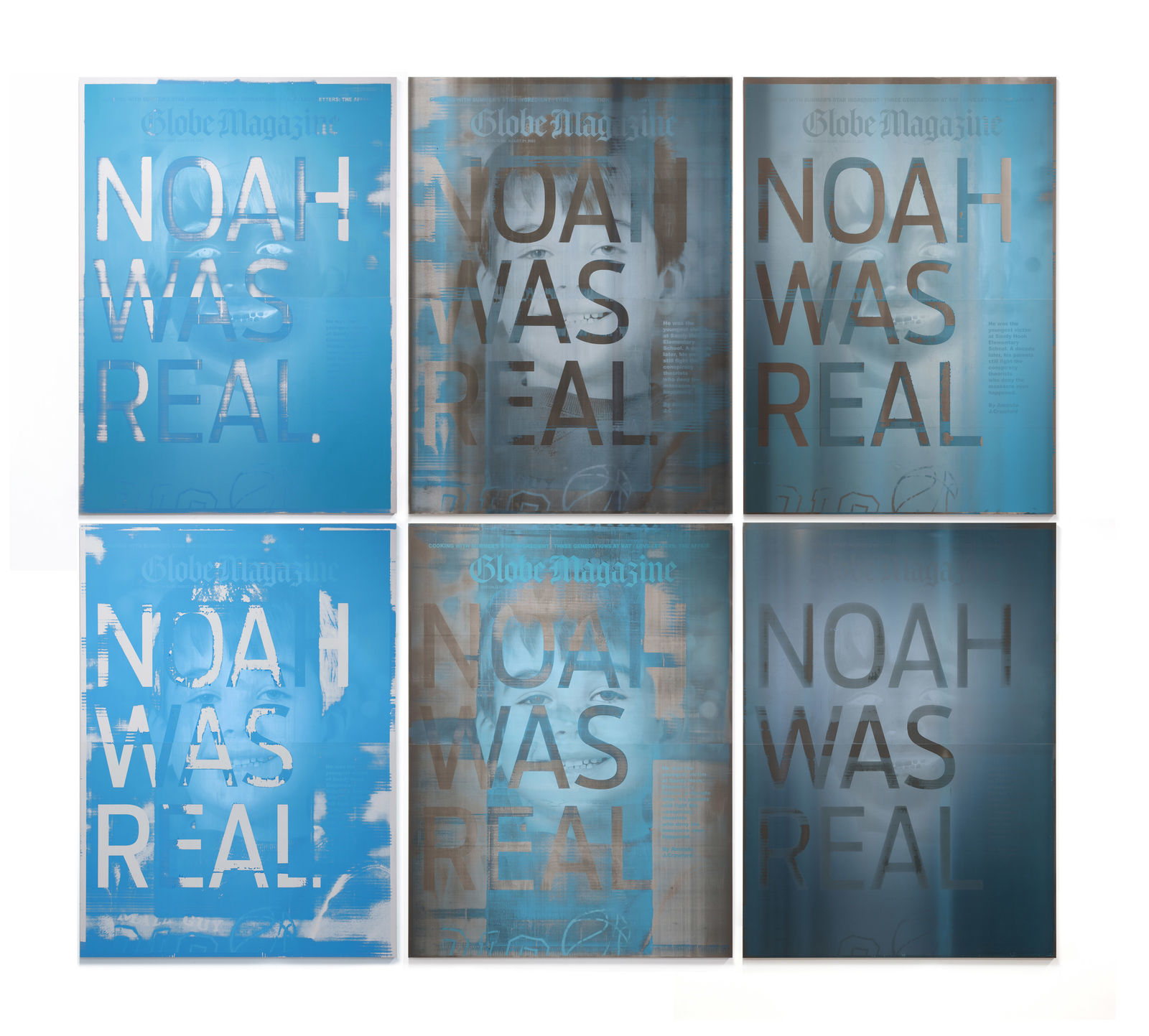
Memento 58 (NOAH WAS REAL), 2024
Newspaper .3mm aluminum offset plates mounted on aluminum frame
275 x 302.5 x 2.5 cm
108 1/4 x 119 1/8 x 1 in
Each panel:
134.8 x 97.5 x 2.5 cm
53 1/8 x 38 3/8 x 1 in
108 1/4 x 119 1/8 x 1 in
Each panel:
134.8 x 97.5 x 2.5 cm
53 1/8 x 38 3/8 x 1 in
Copyright The Artist & Harlan Levey Projects
As light strikes the six panels, the image flickers in and out of view. These reflective metal surfaces—offset printing plates—have been diverted from their original industrial purpose and reimagined by...
As light strikes the six panels, the image flickers in and out of view. These reflective metal surfaces—offset printing plates—have been diverted from their original industrial purpose and reimagined by Emmanuel Van der Auwera as part of Memento, a series spanning nearly a decade (2016–2025). In his hands, tools of mass reproduction become unique works of art: the plates, typically hidden within the newspaper-printing process, are transformed into luminous, painterly surfaces that explore light and depth.
Over the years, Van der Auwera has pushed the boundaries of this medium, manipulating solvents to darken the plates or exposing them to bleach images almost into absence. Of the 63 works in the Memento series, Memento 58 (NOAH WAS REAL) stands alone in bringing together all of these formal techniques—a culmination that insists on the idea of repetition and return.
The panels feature a 2022 Globe Magazine cover: a smiling child beneath the headline, “NOAH WAS REAL.” The text is always legible; the child’s image emerges only under certain light, often revealed through his eyes, from which the rest of his face must be reconstructed. His name is Noah Pozner, the youngest victim of the Sandy Hook Elementary School shooting. The photograph is his final yearbook portrait.
The Globe article reflects on the Pozner family’s grief a decade after the tragedy—years shadowed by toxic conspiracy theories: that the grieving parents were actors, that Noah never existed, that the massacre was a hoax orchestrated by the so-called Deep State. These lies proliferated online, driven by alt-right figures like Alex Jones. At one point, Noah’s father, Leonard Pozner, was forced into hiding.
Van der Auwera sees Sandy Hook as a critical rupture in the relationship between media and public trust—a moment when the cracks in traditional journalism became unmistakable. It marks, in his view, the beginning of the post-truth era. Nearly 13 years later, Memento 58 (NOAH WAS REAL) measures the emotional and cultural aftermath of that moment, closing the Memento series as offset printing itself fades into obsolescence; the newspaper plant where Van der Auwera once worked has since shut down.
“The manner in which human sense perception is organized, the medium in which it is accomplished, is determined not only by nature but by historical circumstances as well.”* In the delicate interplay of light and absence, Van der Auwera’s repetition of “NOAH WAS REAL” stands as a powerful tribute to the young boy whose life was stolen, a defiant rejection of the lies that sought to erase him, and a reminder that truth, despite its distortions, endures.
* Walter Benjamin, “The Work of Art in the Age of Mechanical Reproduction”, 1935, p.5
Over the years, Van der Auwera has pushed the boundaries of this medium, manipulating solvents to darken the plates or exposing them to bleach images almost into absence. Of the 63 works in the Memento series, Memento 58 (NOAH WAS REAL) stands alone in bringing together all of these formal techniques—a culmination that insists on the idea of repetition and return.
The panels feature a 2022 Globe Magazine cover: a smiling child beneath the headline, “NOAH WAS REAL.” The text is always legible; the child’s image emerges only under certain light, often revealed through his eyes, from which the rest of his face must be reconstructed. His name is Noah Pozner, the youngest victim of the Sandy Hook Elementary School shooting. The photograph is his final yearbook portrait.
The Globe article reflects on the Pozner family’s grief a decade after the tragedy—years shadowed by toxic conspiracy theories: that the grieving parents were actors, that Noah never existed, that the massacre was a hoax orchestrated by the so-called Deep State. These lies proliferated online, driven by alt-right figures like Alex Jones. At one point, Noah’s father, Leonard Pozner, was forced into hiding.
Van der Auwera sees Sandy Hook as a critical rupture in the relationship between media and public trust—a moment when the cracks in traditional journalism became unmistakable. It marks, in his view, the beginning of the post-truth era. Nearly 13 years later, Memento 58 (NOAH WAS REAL) measures the emotional and cultural aftermath of that moment, closing the Memento series as offset printing itself fades into obsolescence; the newspaper plant where Van der Auwera once worked has since shut down.
“The manner in which human sense perception is organized, the medium in which it is accomplished, is determined not only by nature but by historical circumstances as well.”* In the delicate interplay of light and absence, Van der Auwera’s repetition of “NOAH WAS REAL” stands as a powerful tribute to the young boy whose life was stolen, a defiant rejection of the lies that sought to erase him, and a reminder that truth, despite its distortions, endures.
* Walter Benjamin, “The Work of Art in the Age of Mechanical Reproduction”, 1935, p.5